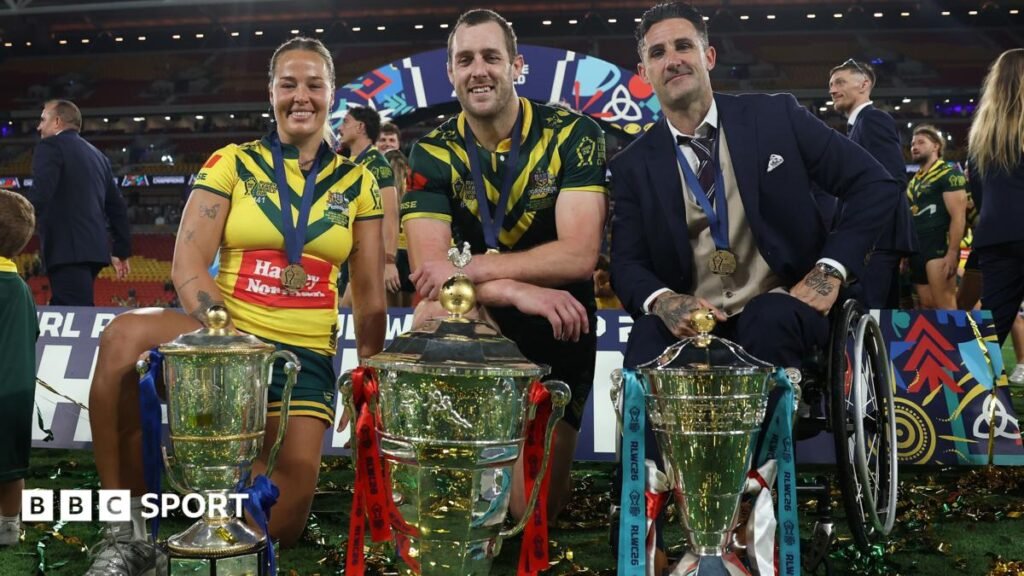
Has the 2026 Rugby League World Cup been a success or not?
It depends on who you listen to – and perhaps where in the world you are.
The men’s, women’s and wheelchair tournaments provided plenty of stories – from Kalyn Ponga’s return from a broken arm in 23 days, to Jodie Cunningham’s mangled ear,, external to the England wheelchair team’s golden ladder, to the men’s group format that caused widespread bafflement.
But was the World Cup a triumph? The northern and southern hemisphere perspectives provide contrasting answers.
For the fourth tournament running, Australia won the men’s and women’s titles, with New Zealand unable to deliver a twist in either final.
Tonga and Samoa brought vibrancy and passion – performing to a level that underlined why they are being elevated to Tier One status. The large Polynesian population in the USA – which will co-host the 2030 men’s and women’s World Cups – is likely to be key in spreading the rugby league word further around the world.
England’s Wheelchair World Cup win, in a thunderous final against their old foes France, offset some of the disappointment felt when Brian McDermott’s men and Stuart Barrow’s women went home early.
And unlike when the game was emerging from post-pandemic constraints in 2022, the tournament has also worked financially by posting a profit.
“This whole tournament’s been incredible,” said Australia men’s captain Isaah Yeo.
“Not just the fans here for New Zealand and Australia, but just everyone. I thought it was all outstanding.
“I think it’s to date the most competitive and the best World Cup there’s been. I think that’s only going to continue to grow.”
That sentiment has been endorsed repeatedly by Australian television broadcaster Channel Seven, which paid a reported A$12m (£6.1m) for exclusive domestic free-to-air coverage of the men’s, women’s and wheelchair tournaments.
Not everyone has been able to feel that positivity, though.
The decision to cut the men’s tournament from 16 teams to 10 reduced the overall number of matches – and deprived teams such as Jamaica and Greece of a chance to build on the feelgood factor they provided as debutants in 2022.
That decision was made after Australia stepped in to stage the tournament, postponed for a year when scheduled hosts France pulled out for financial reasons.
For those who did get to the party this time, it has not always been an even contest. The disparity between the haves and have-nots has been significant.
While the Jillaroos and Kangaroos players will each receive equal payments of $40,000 (£20,500) for competing, Wales will reportedly spread a total of $15,000 (£7,689) across their women’s and wheelchair teams., external
Viewer access to the World Cup has varied too. While Australia had free-to-air live television coverage, fans in the UK only got it for the wheelchair final, shown on BBC iPlayer. For all other games, they needed a Premier Sports subscription, which was also the only way to watch the tournament in North America.
With many matches staged at times when British and American viewers were likely to be in bed, it feels as if a chance to spread the game’s gospel has been missed.
Leave a Reply